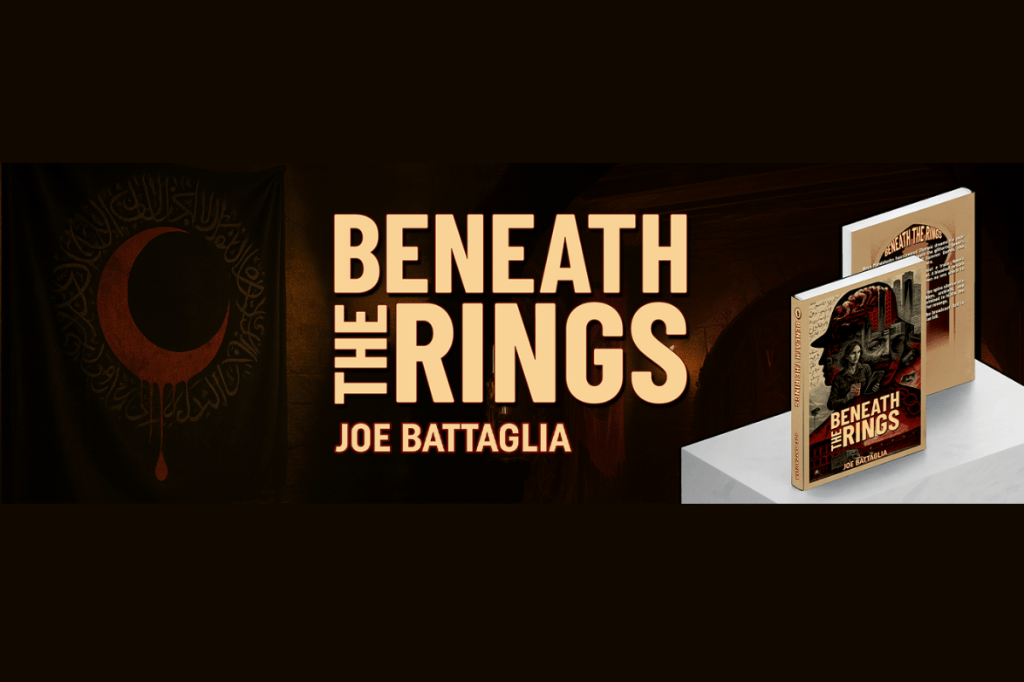
In an era when global sporting events are marketed as symbols of unity, peace, and excellence, few pause to examine what lies beneath the carefully choreographed ceremonies and billion-dollar broadcasts. Author and journalist Joe Battaglia does exactly that in his published sports thriller Beneath The Rings, a novel that peels back the polished surface of the Olympic Games to expose the political tension, moral compromise, and human vulnerability that often remain unseen.
Battaglia’s background in journalism informs every layer of the novel. His approach to fiction is investigative by nature, grounded in research and shaped by years of questioning official narratives. Rather than treating sport as mere competition, he presents it as a global stage where power, nationalism, and ideology intersect. The Olympics, in his view, are not neutral ground but a high-stakes arena where ideals are tested under extreme pressure.
Beneath The Rings unfolds through multiple perspectives, including athletes, journalists, security officials, and political actors, all caught in a crisis that challenges the very principles the Games claim to uphold. Battaglia structures the novel in “Veils,” a narrative choice that allows readers to experience events from different angles while gradually revealing how truth is fragmented by media, authority, and fear. This layered storytelling reinforces one of the book’s central questions: who controls the story when everything is on the line?
What sets Battaglia’s work apart is his restraint. While the novel confronts themes such as terrorism, captivity, and political violence, it resists sensationalism. The tension is not driven by spectacle alone but by the internal struggles of characters forced to make impossible choices. Violence is never gratuitous; instead, it functions as a pressure point that exposes character, ethics, and accountability.

At its core, Beneath The Rings challenges traditional ideas of heroism. Battaglia argues that courage is not limited to physical endurance or public triumph but extends to moral resistance and the refusal to surrender one’s humanity. His athletes are not invincible icons, and his journalists are not detached observers. They are individuals navigating systems that reward silence and punish dissent.
The novel also speaks to a broader cultural moment. As mega-events continue to grow in scale and influence, they increasingly serve as tools of soft power, capable of masking inequality and suppressing uncomfortable truths. Battaglia’s story asks readers to consider the cost of this spectacle and who ultimately pays for it. In a world shaped by information warfare, rising extremism, and media manipulation, these questions feel particularly urgent.
Battaglia does not position himself as a moral authority offering solutions. Instead, his mission as an author is to unsettle. He believes thrillers can do more than entertain; they can interrogate systems of power and force readers to confront uncomfortable realities without preaching. This balance between narrative drive and ethical inquiry is what gives Beneath The Rings its lasting impact.
Looking ahead, Battaglia plans to continue exploring stories at the intersection of sport, geopolitics, and moral consequence. Beneath The Rings opens a larger narrative universe, one that reflects a world where ideals are fragile, institutions are flawed, and silence is rarely accidental.
For readers seeking a thriller with substance, Beneath The Rings offers more than suspense. It offers a mirror one that reflects not only the global games we celebrate, but the uncomfortable truths we often choose not to see.Beneath The Rings is now available to readers worldwide. More information about the book, along with purchasing options and updates on Battaglia’s work, can be found at booksbybattaglia.com




 New York Herald
Leave a comment