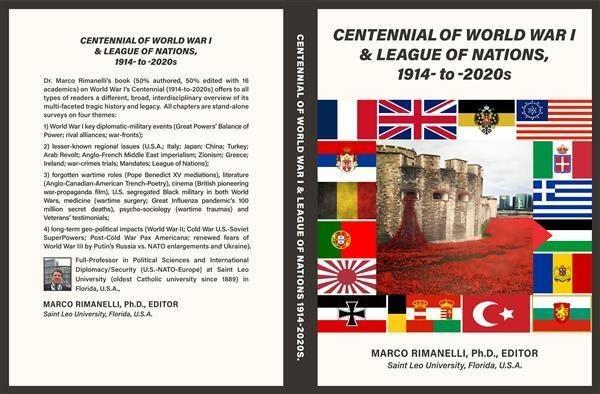
In a quiet corner of Saint Leo University, near Tampa, Florida, surrounded by shelves of historical records and artifacts, Dr. Marco Rimanelli reflects on a conflict that, in his view, never truly ended. For Dr. Rimanelli, a 2013-14 Fulbright-Schuman Chair and Professor of International Security, the 1914-18 First World War is not merely a subject of study, but a lasting warning whose lessons continue to shape today’s fragile global order.
His latest book, Centennial of World War I and League of Nations to Today, 1914–2025 (2026), arrives at a moment of rising international tension. As Russia’s 2022 invasion of Ukraine grinds on and new strategic alignments against the West emerge among Russia, China, Iran and North Korea, Dr. Rimanelli argues that the world is once again drifting toward the same systemic failures that plunged Europe into catastrophe in 1914.
“Those who do not remember the past are condemned to repeat it,” Dr. Rimanelli says, invoking George Santayana, a quote that serves as the guiding principle of his 470-page interdisciplinary work.
The Trigger Versus the Trend
Historians have long debated whether World War I was the result of a tragic accident or an unavoidable outcome of deeper forces. Dr. Rimanelli suggests it was both. While the assassination of Austria-Hungary’s heir to the throne Archduke Franz-Ferdinand in Sarajevo is often cited as the decisive moment, his analysis makes clear that the event merely ignited a system already primed for disaster.
The book challenges the traditional “Fischer Thesis,” which largely attributes blame to Germany’s internal political pressures. Instead, Dr. Rimanelli presents a broader systemic perspective, emphasizing how rigid alliance structures in peacetime (Germany’s led Triple Alliance vs. France’s led Entente), combined with inflexible mobilization schedules, curtailed opportunities for diplomacy once the crisis began.
Once the machinery of war was set in motion, he argues, no single nation could easily stop it, especially when they thought, wrongly, that it would be just a brief bloodletting.
A New Global Dualism
One of the book’s most striking arguments is the parallel Dr. Rimanelli draws between the pre-1914 world and today’s geopolitical environment. He describes the post-2021 current era as a “New Global Strategic Powers Confrontation,” marked by the gradual erosion of a unipolar, U.S.-led international system and the rise of a more unstable global dualism.
“In the post–Cold War period, Russia and China largely cooperated with the West, while ex-Communist Eastern Europe joined the West through the NATO alliance and European Union,” Dr. Rimanelli explained. “But with Vladimir Putin’s dictatorial consolidation of power in Russia and Xi Jinping control of Communist China that cooperation gave way to resistance and confrontation well before 2014, starting with the Crimean Crisis and accelerating after 2021 once the U.S. withdrew from Afghanistan and was perceived as a weak SuperPower by its rivals.”
From the Russo-Ukraine War to constant tensions over Taiwan, Dr. Rimanelli sees these developments not as isolated crises, but as another revival of 19th-Century imperial ambitions and regional wars, which both the League of Nations, and later the United Nations, were created to restrain.
The American Pivot
Dr. Rimanelli also offers a measured but pointed assessment of American foreign policy, tracing its evolution from President Theodore Roosevelt’s pragmatic realism to President Woodrow Wilson’s idealistic vision of collective security. While Roosevelt believed the United States must join the global balance of power against the hegemonic threat from Germany. Wilson sought to transcend that system altogether through the League of Nations as a world international institution to abolish war, promote peace, free trade and International Law.
Unresolved tensions between global engagement and semi-isolationist withdrawal, Dr. Rimanelli argues, continues to define U.S. policy today. History, he warns, offers a clear lesson: when the United States retreats from global leadership as it did during the InterWars years, power vacuums rarely remain empty. They are often filled by authoritarian regimes willing to exploit instability for their own imperialist expansions (Imperial Germany in World War I; Nazi Germany in World War II; Communist Soviet Russia in the Cold War; and today Putin’s Nationalist Russia against Ukraine, U.S. interests and NATO, or Xi’s Communist China against U.S. interests and Taiwan).
The Cost of Forgetting
Beyond strategy and diplomacy, the Centennial of World War I and the League of Nations to Today never loses sight of the human cost of global conflict. Dr. Rimanelli weaves together military history and Great Powers’ rival diplomacy to dominate East Europe and partition the Ottoman Middle East. He also brings out forgotten cultural memories, drawing on the trench poetry of John McCrae, Isaac Rosenberg and John A. Wyeth, or the role of wartime medicine, or recounting the staggering losses suffered by all sides, including almost 5 millions U.S. forces with African-American troops that helped win the war for the Allies, at the cost of over 116,000 deaths just in Fall 1918.
These stories serve as reminders that “total war” is not an abstraction, but a lived historical experience measured in lives lost and societies scarred, as well as the unpublished memories of unknown witnesses of those times, like Italy’s gold medal Captain Ettore Chiurazzi (retired as General by 1945) or the multigenerational Hungarian Nówotny family between Europe and the Ottoman-Turkish Near East
As the world now reorders itself into a new bipolar confrontation since the 2020s, Dr. Rimanelli’s central message is unmistakable: the “long” peace first established in Europe from 1870 to 1914 before the Great War, and again after World War II from 1945 to 2021, is neither permanent nor guaranteed. It is a fragile achievement sustained through cooperation, alliances like NATO, and a collective commitment to remembering the past.
“The world is always a mixture of traditional rivalries and idealism,” Dr. Rimanelli reflects. If his analysis holds true, the 1914-18 Great War never truly ended; its hard lessons in blood, treasury and resolve against rising common global threats were willingly forgotten by new cycles of inward-looking generations blindly seeking peace at any cost, like in 1919-39, or 1945-2021, or today once again.

 New York Herald
Leave a comment