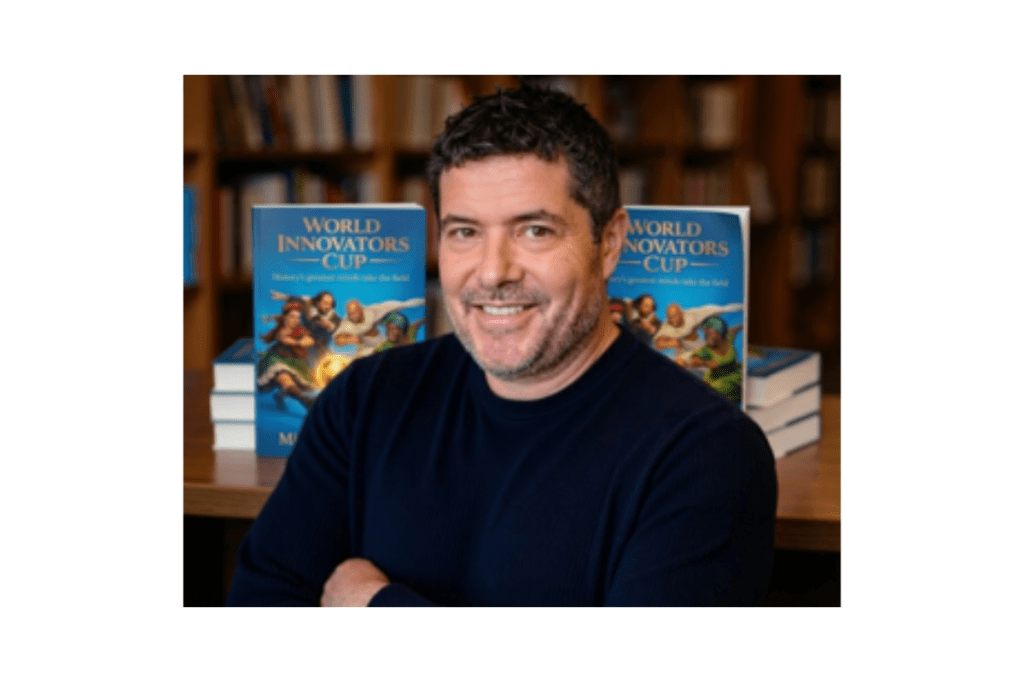
Shakespeare in Midfield, Tesla Up Front: History Enters the World Cup
What if Marie Curie and Ada Lovelace anchored Europe’s defense in the World Cup? What if Gandhi orchestrated attacks from midfield while Genghis Khan led the strike force? What if Tesla versus Edison finally found resolution not in a laboratory but on a football pitch, under stadium lights, with the world watching?
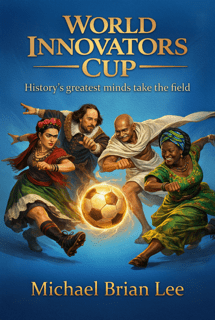
Michael Brian Lee’s World Innovators Cup answers these delicious “what ifs” with a book so audaciously original that it redefines educational entertainment. This is a revolution disguised as a game, a history lesson wrapped in sports fantasy, quite possibly the most fun you’ll ever have learning about the people who shaped our world.
The premise: 56 of history’s greatest innovators—from Hero of Alexandria to Bitcoin’s mysterious Satoshi Nakamoto—organized into four continental teams (Africa, Americas, Asia, Europe) competing in a World Cup tournament. Lee’s execution transforms this playful concept into a masterclass in creative pedagogy that makes you laugh, think, and frantically Google historical figures you suddenly need to know everything about.
Lee understands something fundamental: facts stick when wrapped in stories, and stories become unforgettable when infused with joy. Each innovator gets a full player profile—position, years active, signature move, and meticulously researched biography. Then comes the magic: Lee weaves their real achievements into fictional football narratives so cleverly that the parallels between actual innovations and imagined athletic prowess become an irresistible puzzle.
Take Ibn Battuta, the 14th-century Moroccan explorer who traveled over 70,000 miles. Lee positions him as a “shadow striker” whose signature move is “The Compass Turn.” The fictional account describes him as “football’s first great journeyman,” playing for teams from Timbuktu to Hangzhou, switching jerseys at halftime in a Delhi qualifier. It’s brilliant. Suddenly, you understand Ibn Battuta’s historical significance in a way no textbook ever conveyed.
Or consider Yaa Asantewaa, the Ghanaian Queen Mother who led the 1900 War of the Golden Stool against British colonizers. Her signature move? “The Lioness’ Roar”—a long-range strike carrying her defiance across the pitch. The fictional 1900 Akan Cup Final becomes a metaphor for sovereignty itself. When Yaa Asantewaa demands, “If you, the men of Ashanti, will not shoot, then we, the women, will,” the line lands with double force—adapted from her actual war cry, capturing everything about her leadership.
The book’s structure is transparent—biographies are 100% true, signature moves and match stories are 100% invented, and real quotes are adapted for football context (with originals listed at book’s end). Readers learn to distinguish between historical record and creative interpretation, a skill desperately needed in our post-truth era.
A Roster That Rewrites the Canon
The book is gorgeously inclusive, challenging conventional historical narratives. Africa receives equal billing with Europe, reflecting historical reality rather than Western bias. The roster features overlooked innovators: Fatima al-Fihriya, who founded the world’s first degree-granting university in 859 CE; Khertek Anchimaa-Toka, the first elected female head of state; David Unaipon, the Australian Aboriginal inventor whose face appears on Australia’s $50 note but whose story remains largely unknown.
The gender balance is equally striking. Alongside Shakespeare and Ben Franklin are women who fundamentally reshaped their fields: al-Fihriya and Anchiaa-Toka; Hedy Lamarr, who co-invented frequency-hopping technology foundational to Wi-Fi and Bluetooth; Chien-Shiung Wu, whose work on beta decay changed nuclear physics; Murasaki Shikibu, who wrote the world’s first novel in 11th-century Japan; Frida Kahlo, who transformed how women understand identity through art.
“Far too often, innovation is treated as a technical subject when in reality it is deeply human,” Lee explains. “It is about identity, courage, style, and imagination.” This philosophy permeates the book’s structure. The diversity isn’t performative—it’s a statement about who built our world and a challenge to expand our understanding of what innovation looks like.
The football metaphors are sophisticated. Mansa Musa’s coaching style, “The Caravan,” mirrors his historical governance: “organized, patient, and built on abundance.” Fela Kuti’s “Zombie No Go Go” slows opponents into a trance before explosive attacks—exactly how his Afrobeat music worked. Al-Fihriya’s “Arch of Insight” has defenders guarding spaces rather than players, mirroring her educational philosophy of creating systems that outlast individuals.
Lee connects each innovator to actual matches from their nation’s football history, grounding fantasy in real sporting heritage. Morocco’s 1986 victory over Portugal, Nigeria’s 1978 bronze medal controversy, Ghana’s 2010 triumph—these carefully chosen moments echo the innovator’s historical impact, creating layers of meaning that reward close reading.
The book’s format encourages non-linear exploration. Lee explicitly tells readers not to read cover-to-cover but to “flip through like a sticker album.” This isn’t laziness—it’s recognition that curiosity-driven learning beats forced sequential consumption.
Illustrator Zara Yasin’s contributions add another dimension, with sports trading cards that cement these innovators in readers’ imaginations, making abstract historical figures into vivid, memorable characters.
Who is this book for? Parents desperate to make history engaging. Teachers seeking fresh inspiration. Sports fans wanting their passion connected to larger human achievements. History buffs who appreciate irreverent creativity. Anyone who believes learning should be joyful.
World Innovators Cup arrives at a perfect moment. In an age of shortened attention spans, Lee offers something radically different: a book demanding active engagement, rewarding curiosity, and trusting readers to make connections. It’s educational without being didactic, entertaining without being shallow, and inclusive without being preachy.
The tournament structure means there’s a winner (no spoilers), but the real victory is Lee’s demonstration that biography doesn’t have to be boring, that history can be hilarious, and that the best way to honor great innovators is to innovate how we tell their stories.
“Innovation is not just about inventing the future,” Lee reflects. “It is about redesigning the present.”
This book will sit on coffee tables and spark conversations. Send readers to Wikipedia at 2 AM. Make you see both football and history differently. Make you wish your teachers had been this creative.
Get this book. Read it with your kids, students, friends. Argue about team selections. Create your own dream matches. And remember: as Mansa Musa says, “I don’t play football to dominate. I play to enrich.”
World Innovators Cup enriches everyone who opens it. That’s not just a great book—it’s a gift.


 New York Herald
Leave a comment