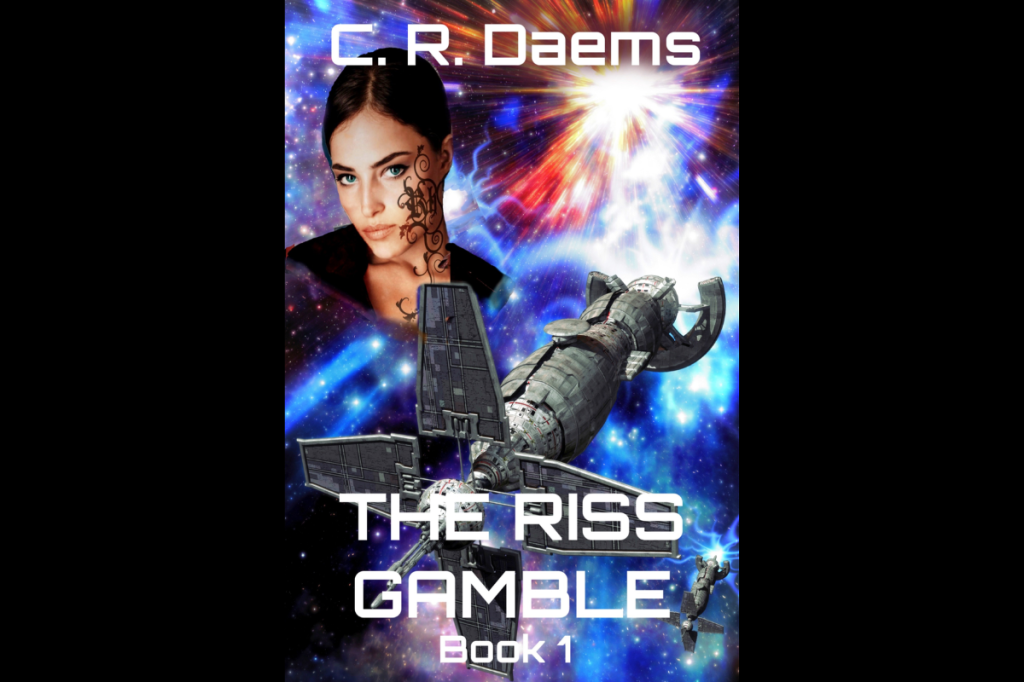
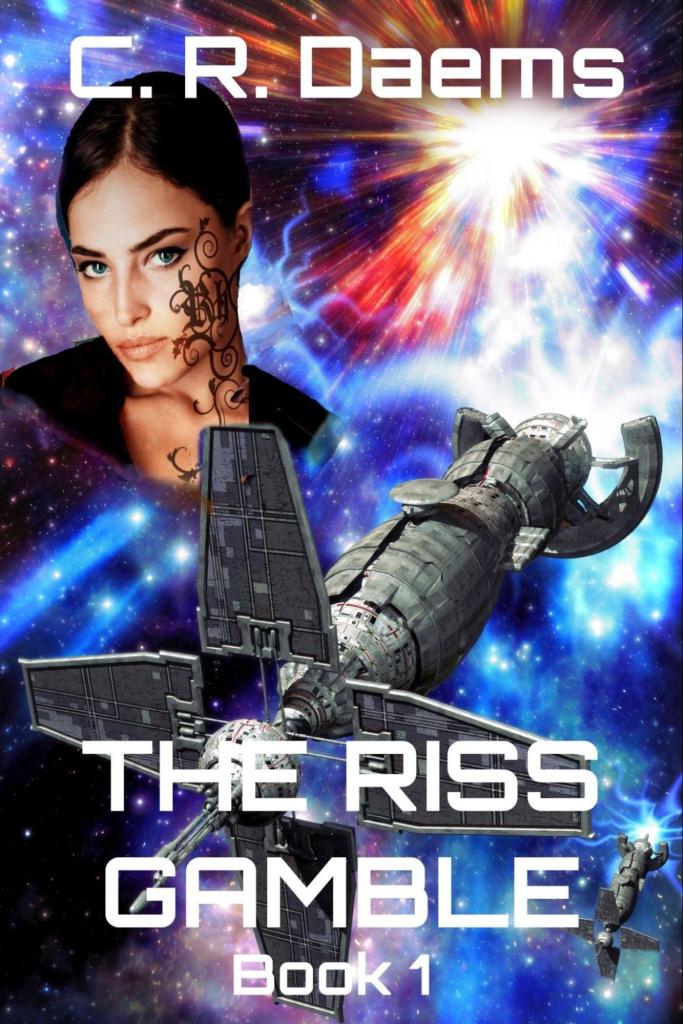
At 70, C.R. Daems, known to friends and readers as Clem, published his first novel. A former U.S. Air Force veteran with degrees in mathematics and computer science, followed by two decades developing technical training at Digital Equipment Corporation, he had never taken a writing course or harbored literary ambitions. Yet one morning an idea arrived unbidden: a parasite that could seize control of a host’s nervous system, evolving from predator to symbiotic partner. That spark became The Riss Gamble, the opening salvo in a six-book military space-opera series that has quietly built a loyal following through word-of-mouth and consistently strong reader ratings.
The book opens on the gray mining colony of Corona, where a slight, mechanically gifted young woman named Nadya Reese stares at a black-wrapped package bearing the emblem of the Sadr Alliance of Stars. Nadya dreams of leaving her planet-bound life to see the stars and meet aliens. Acceptance into the elite Riss Project promises a naval commission and a university education at the irreversible cost of hosting a Riss, a telepathic alien that will fuse with her brain and spinal cord for life. What begins as a Faustian bargain for adventure becomes a profound exploration of partnership, prejudice, and identity. “The body becomes a vehicle,” Daems explained in a recent interview, “and it’s two individuals controlling it.”
Readers meet Nadya as an unlikely heroine: young, undereducated by elite standards, and physically slight under standard gravity. Yet her mechanical intuition and quiet determination carry her through rigorous selection. Once bonded with her Riss, whom she names Thalia after one of the Three Graces, the story shifts. Their relationship evolves from wary coexistence to playful banter and finally to seamless teamwork. The Riss, ancient philosophers who communicate in streaming visual thought, bring centuries of memory and a patient, non-violent worldview that contrasts sharply with human ambition and tribalism.
Daems grounds his interstellar politics in familiar military realism. The Sadr Alliance Navy delivers medical supplies and planetary defense systems as often as it fights raiders. Battles are tactical and costly; damage reports accumulate with grim precision. Prejudice against “Riss-humans,” marked by a distinctive facial tattoo, runs through the fleet like an undercurrent, forcing Nadya and her fellow hosts to prove their loyalty repeatedly. The theme resonates beyond the page: in an era when humans debate artificial intelligence, genetic editing, and human augmentation, The Riss Gamble asks what it means to share one’s mind with another sentient being and whether fear of the “other” will always outweigh the potential for mutual growth.
The author’s unconventional path informs the series’ distinctive voice. Daems writes in first person, a choice he adopted after admiring David Weber’s Honor Harrington novels, and centers nearly all his protagonists as intelligent women. He claims no grand agenda. “There was really no purpose,” he said of the book’s genesis. “I stepped into the main character’s role, and it’s kind of like I’m watching the story develop.” This organic process yields fast-paced narratives that prioritize character decisions over exhaustive world-building. Technical details of missile trajectories, gravity adjustments, and symbiotic neural enhancements feel lived-in rather than lectured. Readers frequently praise the books’ momentum and the warm, sisterly bond between Nadya and Thalia, even as some note occasional editing rough spots typical of an indie author who began publishing later in life.
Daems has produced roughly 38 novels across science fiction, fantasy, and hybrid “science fiction fantasy” subgenres. Many feature animal or alien companions that function as partners rather than pets: a truth-sensing snake in the popular Red Angel series, for instance. He publishes primarily through his own Talon Novels imprint, with e-books, paperbacks, and audiobooks available. Sales remain modest by blockbuster standards, and fans return for the reliable pleasure of competent heroines solving problems with wits, alliances, and moral clarity rather than grimdark cynicism.
In conversation, Daems speaks with the easy cadence of someone who has lived multiple lives. Born in Chicago, he served 22 years in the Air Force, practiced Kung Fu, raised a family, and retired into a second career before the writing bug bit. He describes the craft as a satisfying hobby that became a late vocation. “I’ve kind of been reborn every 20 years,” he reflected. Medical challenges slowed recent output, but he hopes to finish a new project within months. When asked what he wants readers to take away, his answer is characteristically modest: “an enjoyable 8- to 10-hour read” with clever solutions and characters worth rooting for.
The Riss Gamble and its sequels will not reshape the literary canon or dominate bestseller lists. They do not aspire to. Instead, they offer something increasingly rare in genre fiction: optimistic competence, cross-species friendship forged under pressure, and the quiet thrill of watching an ordinary young woman grow into a leader who bridges two civilizations. For a man who began writing at an age when many authors retire, that achievement feels less like a gamble than a well-calculated bet on the enduring appeal of wonder, resilience, and partnership.
In an age of polarized futures, Daems’ Riss reminds us that the most radical act may be learning to share the controls and discovering, against all expectations, that two minds steering one body can travel farther than either could alone.
Follow the author’s journey, explore the history behind the novel, and order your copy through the links below.
Amazon: https://tinyurl.com/yw2h6vx5
Facebook: https://tinyurl.com/yb4767ej






Leave a Reply