Swipe through your phone on any given morning, and you are bound to see it: an astrology meme diagnosing your latest romantic failure, a TikTok creator breaking down Venus retrogrades, or a push notification from an app warning you that your Saturn return is about to upend your life.
Astrology has become the ubiquitous language of modern dating and self-discovery. We use it to filter our matches, explain our moods, and justify our toxic traits. But beneath the playful pop-culture surface of sun signs and compatibility charts lies a much older, infinitely more intimidating question: Do we actually have a choice in who we love?
Or are we simply actors walking onto a stage, hitting our marks, and reciting lines written in the stars long before we were born?
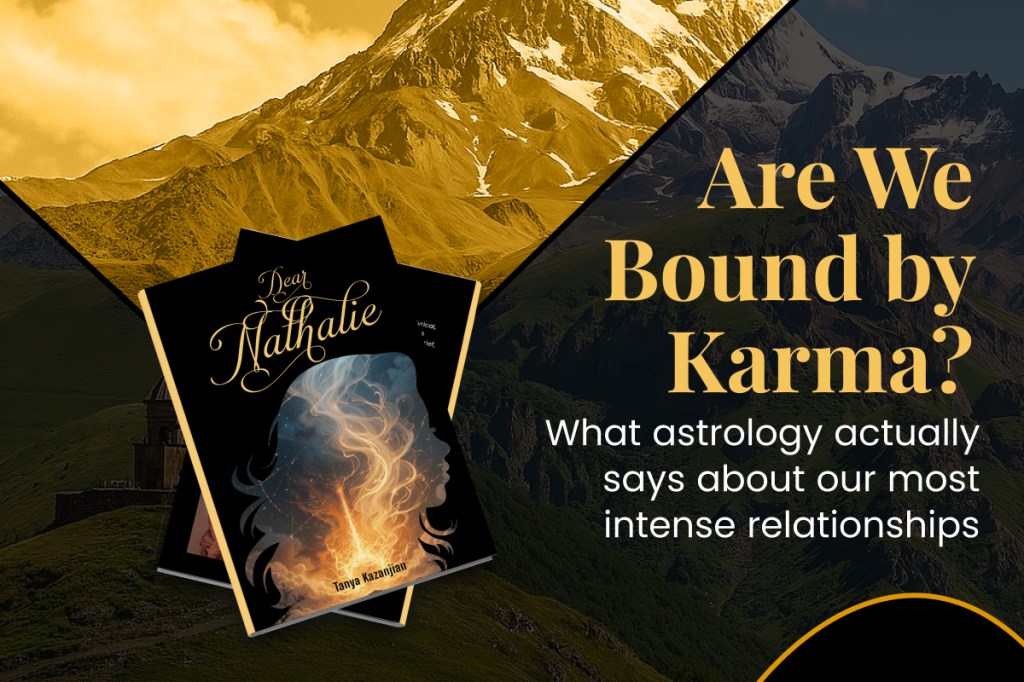
This is the existential terrain explored in Tanya Kazanjian’s stunning literary novella, Dear Nathalie. Through the epistolary exchange between Gregory—a pragmatic, deeply rooted family man—and Nathalie, an empathic poet with a profound grasp of the esoteric, the book strips astrology of its parlor-trick reputation. Instead, it presents it as a terrifyingly accurate map of human karma. Through Nathalie’s eyes, we are forced to confront the idea that our most intense, agonizing, and transformative relationships are not accidental. They are predetermined.
The Affront to Free Will
It is human nature to believe we are the architects of our own destiny. We pride ourselves on the choices we make: the careers we pursue, the cities we move to, and, most importantly, the people we decide to tie our lives to.
But as Nathalie points out in one of her most gripping letters to Gregory, this illusion of control is precisely why so many people reject astrology. “The difficulty with astrology is not that it does not work,” she writes. “It is that it does. The patterns are very precise and infinitely progressible both backwards and forwards.”
When Nathalie asks for Gregory’s birth data, she isn’t looking for a fun parlor trick. She is looking for the architectural blueprint of their connection. What she finds shocks her: Gregory’s chart—complete with a Sun in Cancer, Moon in Pisces, and a hard Saturn-Pluto aspect—is an eerie reflection of her late mother’s chart.
This revelation unlocks a core philosophical tenet of Kazanjian’s book. According to this deeper, esoteric view of astrology, your birth chart reflects the exact people you are destined to meet and the specific experiences you are bound to have. In this framework, your “free will” does not dictate the circumstances of your life; your free will is limited entirely to how you respond to those circumstances.
It is a concept that directly threatens the Western ideal of total individual freedom. If the people who break our hearts, challenge our egos, and upend our lives were always destined to do so, then love is not just a choice. It is an assignment.
The Karmic Wheel and Human Projection
Why do we keep falling for the same type of person? Why do we find ourselves locked in the same maddening arguments with different partners? Psychology might call it repetition compulsion or attachment theory. Nathalie calls it the karmic wheel.
One of the most fascinating concepts explored in Dear Nathalie is the idea that the people we form the closest bonds with are, quite literally, mirrors of our own unresolved issues. When two people share a profound connection, their astrological charts inevitably overlap. In Nathalie’s worldview, this means you are meeting a part of yourself that you carry within you. It is a projection.
“Any conflicts that arise between you is something you have not resolved within yourself, so this is an opportunity,” Nathalie explains. “If you do not reconcile these different aspects of yourself, you will continue to meet the same people over and over again until you do.”
This boils down to a staggering realization: Everyone you meet is you.
When Nathalie meets Gregory, she isn’t just meeting a married colleague. She is meeting the ghost of her childhood, the echo of her lost parents, and the fragmented pieces of her own psyche. Their relationship is a cosmic classroom. And the curriculum is painful. By recognizing that our most difficult relationships are actually mirrors of our internal state, Dear Nathalie shifts the focus of love from romance to evolution. We aren’t drawn to certain people just because they make us happy; we are drawn to them because they hold the key to our healing.
Generational Karma: Ties That Bind
Kazanjian brilliantly expands this concept beyond romantic or platonic love, diving into the deep waters of generational karma. Astrology, in the world of Dear Nathalie, is not confined to the people we interact with daily; it stretches across time, bridging the gap between ancestors and descendants.
This becomes breathtakingly clear when Nathalie studies the horoscope of Madeleine, Gregory’s young daughter—a girl she has never formally met. Looking at the alignment of Madeleine’s Jupiter and her Capricorn Moon positioned on the Nodes, Nathalie identifies a profound past-life connection. She becomes certain that the child was once her grandmother or great-aunt.
It sounds esoteric, perhaps even eccentric, to those unfamiliar with karmic astrology. But Kazanjian writes it with such fierce, grounded conviction that the reader cannot help but believe it. It reframes the way we view the people in our lives. What if the daughter you are raising is an old soul who has returned to teach you a lesson you failed to learn in a previous century? What if the stranger you feel an inexplicable protective urge over is tied to your bloodline in a way science simply cannot track?
Through the lens of astrology, the book suggests that families are not just biological units. They are soul groups, bound by karma, returning to the earth together in different configurations until all debts are paid and all wounds are healed.
Finding Meaning in the Patterns
It is easy to dismiss astrology as fantasy. In fact, Nathalie’s own friends—highly educated, rational academics—do exactly that. But as she eloquently argues, how does any thinking person survive without speculating on our origins? How do we navigate the brutal, random tragedies of life without looking for patterns to give us clues to our purpose?
We accept multi-dimensional realities in astrophysics, and we accept that every character in a novel is a projection of the author’s own mind. Why, then, is it so hard to accept that the universe itself might be operating on a symbolic, mathematical system of spiritual growth?
In Dear Nathalie, the astrology is not there to predict the future. It is there to make sense of the unbearable weight of the present. When Nathalie is overwhelmed by the twin flame connection—by the sheer, unadulterated terror of ego decomposition—she looks to the stars not for an escape, but for an explanation. She wants to know why she is suffering, what she is meant to learn, and how she can break the cycle so she does not have to come back and do it all over again.
The Ultimate Goal: Liberation
If we are bound by karma, and if our birth charts are the blueprints of our spiritual tests, what is the endgame?
For the spiritually curious, Dear Nathalie offers a profound, challenging answer: Liberation. The purpose of these intense, earth-shattering relationships is not to end up happily married with a white picket fence. The purpose is to face every wound, forgive every grievance, and learn unconditional love so completely that the soul no longer needs to reincarnate.
It is a tall order, and as the tragic, beautiful trajectory of Nathalie and Gregory’s story proves, it is a messy, imperfect process. But Kazanjian leaves the reader with a comforting thought. Even if we fail, even if our human stubbornness keeps us tied to the karmic wheel, the universe is endlessly patient. The patterns will progress. The stars will realign. And the souls we are meant to love will find us again, in this life or the next.
Media Details:
Amazon: DEAR NATHALIE
Author: Tanya Kazanjian
Website: www.tanyakazanjian.com






Leave a Reply