
A seven-year-old’s imagination lights up the darkest mystery in Catville.
It is no wonder that children between the ages of five and eight are at the peak of their creative lives, generating ideas with a freedom and fearlessness that most adults have long since been educated out of. We know this, and still we underestimate them. We still assume that storytelling is something you grow into, rather than something you are born overflowing with.

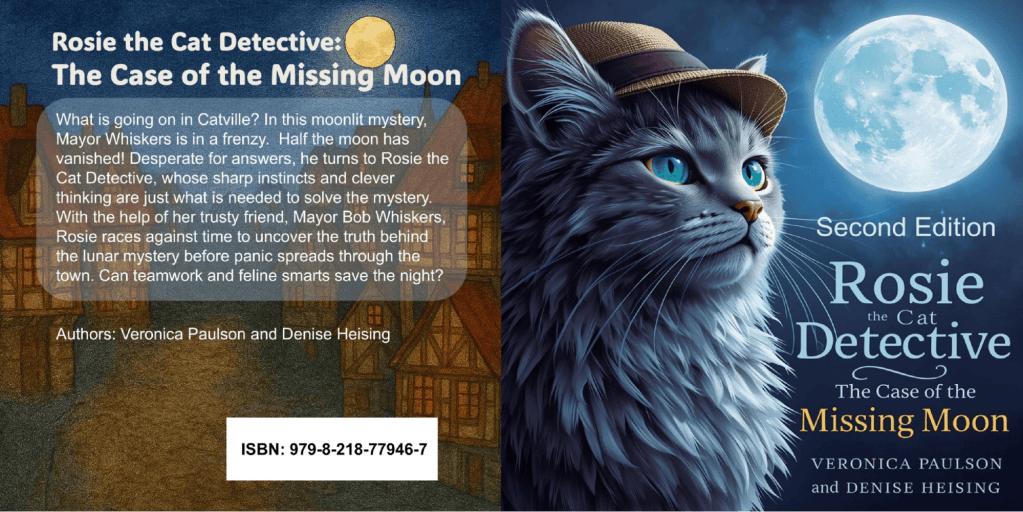
Denise Heising has something unique to say about it. A former educator, artist, and grandmother, Heising built her debut children’s book, Rosie the Cat Detective: The Case of the Missing Moon, published by Forward Boldly Press, around an idea that did not come from a writing desk or a publisher’s brief. It came from her seven-year-old granddaughter, Veronica Paulson, who one day conjured an entire world out of nothing and handed it over in the way children hand things over: with complete confidence that someone would know what to do with it.
But Heising did something worthwhile. The result is the first in a promised series of mysteries set in Catville, a wonderfully imagined little town where every citizen is a cat and civic life runs with cheerful seriousness. It is a short book, brightly illustrated, and aimed squarely at young readers. It is also, in the best possible way, surprising.
A Case of the Missing Moon
The story opens on a perfectly ordinary evening that refuses to stay ordinary. Mayor Bob Whiskers, the proud and moustachioed leader of Catville, steps outside after a long day at City Hall and looks up at the sky. The Farmers’ Almanac has promised a full moon. What he finds instead sends a shiver straight down his tail. What happens next, and how the town’s unflappable head detective Rosie solves the case, is a mystery best discovered on the page rather than in a review.
A Past That Lingers
What deserves attention here is not the plot but the thinking beneath it. In an age of children’s books crowded with spells, sorcerers, and magical quick fixes, Heising imagined something quietly different: a world where the answer to a crisis lives not in a wand but in a book. Where the most valuable thing a community can possess is not power but memory. Where the past, carefully kept and handed down, is what saves the present. That this idea was sparked by a child of seven says something worth sitting with.
The Pure Energy of Childlike Wonder
Heising describes the process of working from her granddaughter’s imagination as an exercise in deep listening. A child’s storytelling does not arrive in neat chapters; it moves, as she puts it, like a parade through town, full of colour and surprise, one idea tumbling after another before the first one finishes. Her role was to follow that parade faithfully, shape its energy into a story a reader could travel from one end to the other, and resist the urge to replace the child’s instincts with an adult’s tidier ones. The result is a book that feels genuinely alive, funny in the right places, warm throughout, and entirely on the side of its young readers.
Solving Mysteries without Magic or Villains
Heising writes at the back of the book that the Rosie series is deliberately free of magic, villains, and paranormal elements. Just mysteries, teamwork, friendship, and curiosity. This is an unusual pledge in today’s children’s publishing landscape, and this first book makes a persuasive case for it. There is real satisfaction in watching a problem solved through patience, partnership, and the willingness to sit in a library at midnight and read. Young readers deserve stories that show them this kind of satisfaction, that tell them their attention matters and their questions lead somewhere real.
A Story That Gives Back Generously
The book’s generosity extends beyond the story itself. Every copy sold supports programs that help victims of domestic abuse. The dedication, drawn from Mark Twain, reminds us that joy only reaches its full value when it is shared with someone else. Both feel entirely in keeping with a book that began as one person listening very carefully to another.
Heising could have written any book. She chose instead to listen to a seven-year-old and follow where the imagination led. In Catville, the moon can go missing. And the person most likely to bring it back is the one who never stopped paying attention.





Leave a Reply