
Some stories feel imagined. Others carry a weight that suggests something closer to the truth.
Ethan Ross writes in that space. His work does not rely solely on spectacle. It draws from structure, discipline, and an understanding of environments where decisions are made under pressure and consequences unfold quickly. After 22 years in the UK military, including 12 years in special operations assignments connected to the Foreign Office, Ross brings a perspective that shapes how his stories move and how tension builds.
His novel Point of No Return reflects that foundation. It introduces readers to a world where intelligence operations remain unseen, where trust is earned under pressure, and where every mission carries a cost beyond its objective.
A Man Who Understands the Weight of Decisions
Ross’s transition into fiction did not begin with invention alone, but with translation.
Early success with a factual work revealed an opportunity to create stories that feel grounded rather than exaggerated. Stories that respect how operations unfold instead of reshaping them for convenience. Ross builds his narratives with that discipline in mind.
Across 20 novels, his approach remains consistent. The focus stays on structure. Events follow logic. Characters respond within the limits of their roles. The writing avoids unnecessary dramatization and instead leans into control and clarity.
Personal experience remains undisclosed. That restraint strengthens the work. Rather than explaining what is real, Ross allows readers to feel it through pacing, detail, and consequence.
Where the Story Begins
Point of No Return marks the beginning of the Jack Copeland series and introduces CIA operative Jack Copeland alongside Elisabeth Young.
The story opens with a high-risk international crisis that demands immediate action. A U.S. Ambassador is taken, and a response team is deployed into a volatile environment where timing and precision matter.
What begins as a clear objective quickly becomes more complex. The situation expands, the stakes rise, and the mission reveals layers that challenge both strategy and trust. The narrative moves forward with purpose, allowing tension to build through uncertainty rather than explanation.
Characters Defined by Pressure, Not Perfection
Jack Copeland operates with discipline, but not without burden.
He leads under pressure while carrying the weight of responsibility. His role is not built on invincibility, but on judgment. Each decision affects more than the mission itself.
Elisabeth Young brings a different dimension. Her presence introduces emotional contrast within a story driven by urgency. She represents a connection to something beyond the operation, grounding the narrative in human stakes.
The wider team reinforces this environment. Each member contributes to the mission while navigating risk, uncertainty, and shifting dynamics. Trust plays a central role, and the story continually tests how far it can be relied upon.
A World That Reflects More Than Fiction
The setting of Point of No Return feels immediate because it draws from recognizable realities.
Global instability, intelligence-led operations, and coordinated threats shape the backdrop. These elements remain controlled within the narrative, giving the story weight without turning it into commentary.
Ross reinforces a quiet but powerful idea. Much of the work that protects international stability happens without visibility. The individuals involved operate in silence, often without recognition.
Tension That Holds From Beginning to End
The novel builds tension through continuity rather than isolated moments.
Time remains a constant pressure. Every delay introduces risk. Each decision shapes what follows. The pacing reflects that urgency without losing clarity.
Emotional depth runs alongside the action. Loyalty, sacrifice, and responsibility shape how characters respond under pressure. The story does not pause to explain these themes. It allows them to emerge through experience.
The result is a reading experience that feels controlled, immediate, and sustained.
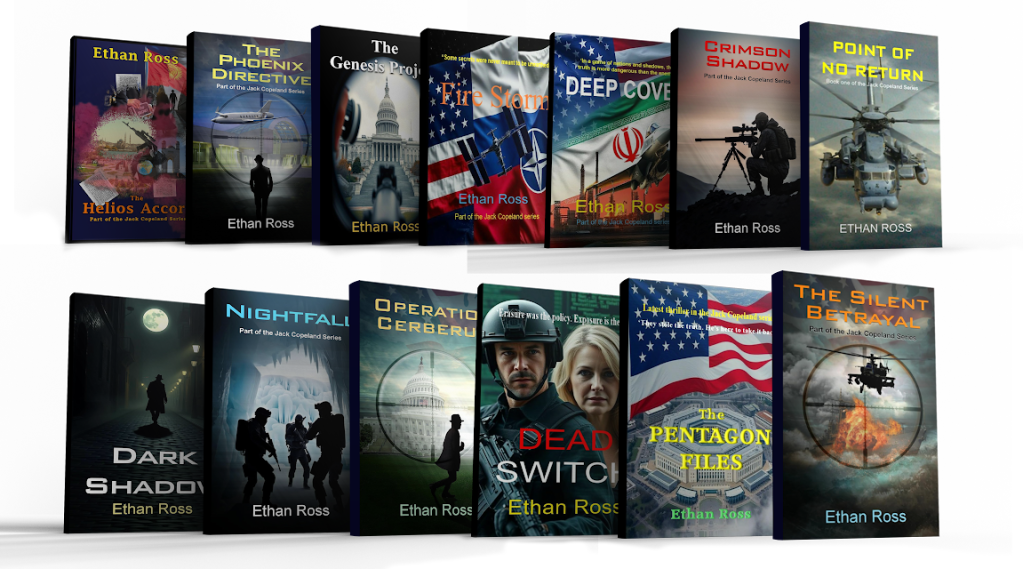
Expanding the World of Jack Copeland
Point of No Return is only the beginning.
Ross has already expanded the Jack Copeland series across multiple novels, building a consistent and evolving world. Each installment reinforces the same disciplined approach to storytelling.
Plans to bring the series to the screen suggest a natural next step. The structure, pacing, and scale of the narrative lend themselves to visual storytelling without requiring reinvention.
Ross writes with an understanding of environments that are rarely explained in detail.
He does not rely on revealing personal experiences. He allows them to shape the narrative from within. The result is a story that feels informed without needing to prove it.
Point of No Return reflects that balance. It delivers a high-stakes narrative grounded in structure, shaped by discipline, and driven by characters who operate under real pressure.
For readers, the experience is direct. The world feels close. The tension holds. The story stays with you.
To experience the magic, visit www.jackcopelandseries.com.
Amazon link: The Jack Copeland crime series
For more information:
Author Ethan Ross (@authorethanross.bsky.social)
Ethan Ross (@authorethanross) • Instagram profile
website: Jack Copeland Series | Best Spy Thriller Books & CIA Novels




Leave a comment