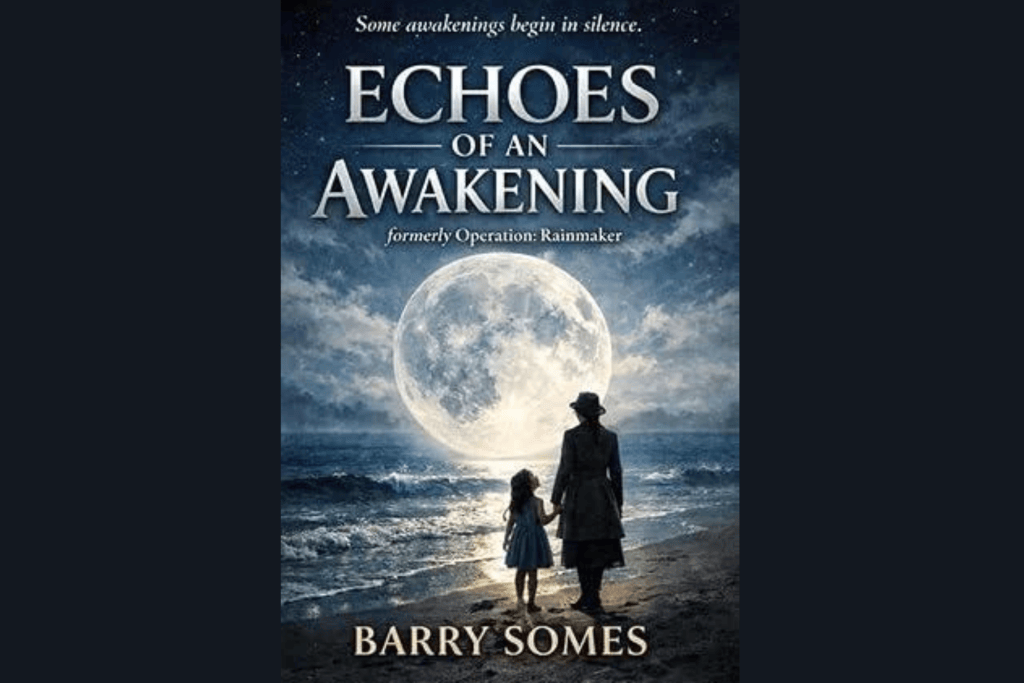
Barry Somes did not set out to write conspiracy fiction. He set out to invent a heroine. A lifelong James Bond devotee who had “seen every James Bond movie” and read shelves of spy novels, Somes noticed a persistent absence: there was no fully realized female counterpart, no Jane Bond who arrived on the page already formed and already lethal. “You can’t really start with one that already exists,” he told an interviewer. “You have to have a story of a girl growing up and becoming a spy.”
That story became Echoes of an Awakening, the first novel in a planned series. Its protagonist, Margo Scarlett, is introduced as a red-haired tomboy on St. Simons Island, Georgia, the only child of a remote, wealthy family whose fortune rests on a Victorian patent for the tiny screws that hold eyeglass frames together. She is brilliant, solitary, and stubborn. At six, she demands karate lessons; by college, she holds an advanced black belt in Brazilian jiu-jitsu and is pursuing a double major in biochemistry and geology at Johns Hopkins. Her senior paper on meteorites accidentally surfaces a tightly held government secret involving lunar samples and an isotope called helium-3.
Helium-3 is the novel’s second engine. Somes encountered the substance in reports of a Canadian mining company’s unsuccessful request for a permit to extract it from the moon. The isotope, carried by solar wind and deposited on the lunar surface over billions of years, is theoretically an almost perfect fusion fuel: abundant energy with no carbon emissions and no long-lived radioactive waste. In the book’s framing, Apollo 11 returned samples containing the isotope; those samples disappeared into a government laboratory and never reappeared in public discussion. Somes’s working theory, and the novel’s central premise, is that the information has been suppressed to protect the fossil-fuel industry. Whether the suppression is real is less important to the narrative than the question it forces on the reader: What if it were?
Margo’s discovery of the secret propels her into the orbit of a shadowy research facility outside Washington. The scientists who run it first try to co-opt her, then to control her, and finally to dispose of her. She is recruited, trained by the CIA, and paired with a seasoned European operative before being dispatched to France to track a colleague who has absconded with the remaining helium-3 and the plans for a working fusion reactor. The mission collapses into betrayal, flight, and a temporary refuge at Goldeneye, the Jamaican estate where Ian Fleming wrote the Bond novels. By the end of the book, Margo has become something she never intended: a field operative who trusts almost no one and who carries the operational habits of the intelligence world into ordinary life.

Somes is candid about the book’s dual ambitions. He wants it to function as entertainment and as quiet provocation. “The one thing I want people to ask themselves after they’ve read the book is, could this be a true story?” He is equally clear about the intended audience. The novel is meant, he says, as “an inspirational book for young women,” a portrait of competence and resilience rather than of glamour. Margo is not conventionally beautiful; she is muscular, intense, and socially awkward. Her power derives from discipline and intellect, not from seduction or inherited connections. When CIA trainers warn her that no woman has yet completed their most demanding course, the warning becomes the incentive.
The novel is the opening volume of a series Somes has already mapped. Subsequent books will revisit secondary characters introduced in the first, most notably Margo’s enigmatic father and the European spy who mentored her and will pull the retired operative back into the field. Each installment, he insists, is designed to stand alone, yet the cumulative effect is the education of a professional. Even in the relative safety of a new identity in Canada, Margo continues to sit facing the door, to inventory exits, to notice who is watching whom. The training does not leave her.
Somes writes with the confidence of a traveler who has walked the streets he describes. Strasbourg, St. Simons, the Maine lake country, the Jamaican north coast these are places he knows. The prose is straightforward, sometimes conversational, closer to oral storytelling than to high literary style. Friends who have read the manuscript have told him they hear his speaking voice on the page. That directness is deliberate. He is less interested in stylistic flourish than in the momentum of a young woman discovering, under pressure, what she is capable of becoming.
Whether Echoes of an Awakening will find the wide audience Somes hopes for remains an open question. The obstacles he cites visibility, the long timeline of film adaptation, the preference of investors for established brands—are real. Yet the novel’s central wager is modest and durable: that a red-haired girl from Georgia who refuses to be sidelined can carry a story about power, secrecy, and the fuel that might one day replace the fuels we know. In an era of renewed interest in both espionage fiction and the politics of energy, that wager feels timely. Somes has written the origin story. The rest of the series will test whether Margo Scarlett can keep answering the call.
Order Your Copy Now:
Amazon: https://a.co/d/0ft4koDZ




Leave a Reply