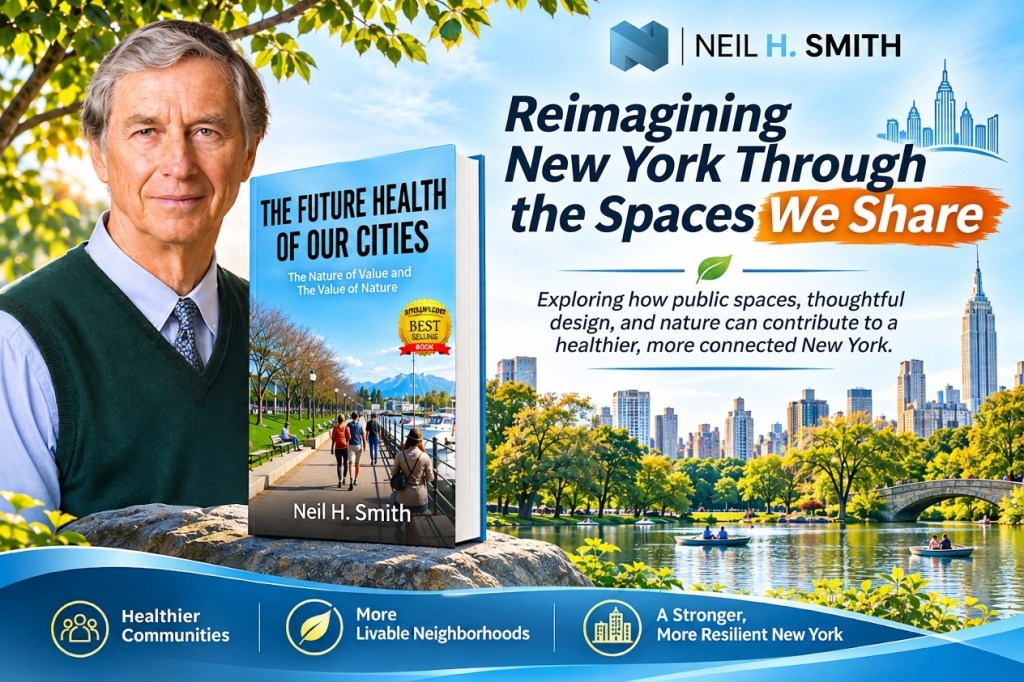
A New York block can change character in half a minute. Step out of a crowded avenue into a pocket park, and the horns soften. Find a bench beneath a tree, and the rush of the day briefly loosens its grip. These small pauses are easy to overlook in a city famous for its towers and speed. Yet they tell us something important: a city is shaped not only by what it builds, but by the places it makes for people to breathe.
That idea carries particular weight in New York, where density is a fact of life and climate pressures are increasingly part of everyday planning. The city’s own climate and health guidance connects extreme heat and flooding with neighborhood conditions, including green space and access to cooling. In other words, resilience is not only a question of large infrastructure. It also concerns the ordinary spaces between home, work, school, and transit.
New York has long shown how public places can alter the way a city is experienced. Central Park gave residents a vast common landscape within a rapidly growing metropolis. The High Line turned an elevated rail structure into a public promenade. Rockefeller Center’s plaza became a destination in its own right, while the development around Battery Park City brought parks and waterfront promenades into the daily life of Lower Manhattan. Each example is different, but all suggest that open space can be central to a successful city, not leftover ground after the buildings are finished. They remind us that some investments are often measured in healthier routines, shared memories, and streets people want to walk.
That is one of the ideas Neil H. Smith explores in The Future Health of Our Cities: The Nature of Value and the Value of Nature. Smith’s book looks at how the physical design of cities affects health, opportunity, environmental quality, and economic life. His experience in real estate and urban development informs a question that matters to every New Yorker: can a city grow in ways that create value for residents as well as investors?
The answer depends in part on what we choose to count as value. A project’s financial return is visible in budgets, leases, and property prices. The benefits of a public square, safe walking route, tree-lined street, or accessible park can be harder to measure, yet they shape daily life. They invite people outside, make neighborhoods more comfortable, and connect buildings to the communities around them. Smith argues that thoughtful design can bring public and private interests together, rather than treating them as opposing goals.
His discussion is wide-ranging. The book considers housing and inequality, parks and promenades, urban density, technology, changing populations, governance, and the future of capitalism. It compares places such as Bogotá, Medellín, Curitiba, Mexico City, São Paulo, and Santiago, while returning to familiar New York examples. The point is not to import a ready-made blueprint. No city can simply transplant another city’s answer. The value lies in seeing how different places respond to common questions about growth, access, and the role of nature in urban life.
For New York, one of those questions is who gets to enjoy the city’s public realm. A waterfront path or beautifully designed plaza matters most when people can reach it, use it, and feel that it belongs to them. The same is true of neighborhood parks and shaded streets. Planning for health means considering how public investment is distributed and whether growth allows a broad range of residents to remain part of the city’s future.
That does not require New York to stop building. It asks the city to consider each project as part of a larger neighborhood. Does it connect people to transit and daily needs? Does it make room for public life? Does it strengthen the area’s ability to handle heat and heavy rain? Does it contribute something useful beyond its own walls? These are practical questions, and they can help make development serve a wider civic purpose.
The city’s most memorable places often offer more than a view. They create a feeling of welcome, give strangers room to share space, or make the walk home a little more humane. In The Future Health of Our Cities, Neil H. Smith asks readers to look at urban success through that human scale. For New York, where every square foot carries competing demands, the book’s message is timely: the places that help people live well are not extras. They are part of what makes a city valuable.





Leave a Reply